Recent Posts

May 27, 2010

Why fish fear their own reflections?


As they swim gently around their tank or bowl, fish tend to enjoy a stress-free existence. But they face one great potential peril, scientists have found. Apparently, if they catch sight of their reflection gawping back at them, they try to fight it.

They are then terrified when their lookalike fights back in exactly the same way. Scientists say the discovery shows how similar their brains are to ours. Biologist Dr Julie Desjardins, who led the study, said: 'I think this indicates there is more going on cognitively than people have long assumed in fish.' Male African cichlids, a territorial species, were either shown their reflection or another fish behind a pane of glass. In both cases the fish tried to fight.

All showed high levels of testosterone and other aggression-inducing hormones in their blood. The fishes' brains were also examined but only those that had fought with their reflection showed high activity in the amygdala, the brain region tied to fear and fear conditioning in all vertebrates - including humans.

Dr Desjardins, of Stanford University, California, said the fear was due to the unfamiliarity of the encounter, adding: 'The fish was not seeing the expected response from its opponent. 'The fact we saw evidence of a really high level of activity in the amygdala is pretty exciting and surprising.'

Source: http://www.dailymail.co.uk/sciencetech/article-1280218/Are-looking-Why-fish-scared-reflection.html

May 10, 2010

World's most expensive hair dresser

Photobucket
Everyone likes to spend big bucks on their hair, but we are talking really big bucks here. I mean like the world's most expensive hairdresser's charges. Stuart Phillips' packages are for those with a fat, let's just say morbidly obese wallet. He offers three VIP packages which are more than just a haircut. The Gold Package starts for $16,300 and features limo ride from the airport to the salon, champagne lunch upon arrival at the salon, hair consultation, head and scalp massage, cut and blow dry from Stuart Phillips himself, instruction to maintain your styling and suggestions for different ways to wear it, a selection of L’Oreal products to take home and limo ride back to the airport after your appointment.

The next in line is the £20,000 ($32,000) Diamond Package which is a two day/night adventure that includes chauffeur driven limo from your home to the airport, first class flight to the UK, limo will pick you up at the airport and take you to one of Britain’s finest hotels, champagne lunch, Stuart Phillips will escort you to the salon, extensive hair consultation, head and scalp massage, haircut, instructions to maintain style and suggestions for different ways of wearing it, selection of L’Oreal products, limo ride back to the hotel, day two to spend as you wish, limo ride back to the airport on the final day, limo ride from airport to your home and a portion of the proceeds go to two different charities.

The third Platinum Package is so expensive that you have contact Stuart Phillips Salon to get a quote. By the way, this package has anything you want including Stuart Phillips coming to you.

Source: http://www.luxurylaunches.com/other_stuff/stuart_phillips_is_the_most_expensive_hair_dresser_in_the_world.php

May 6, 2010

Boy saved from certain death by his ears

Photobucket
A boy in China was saved from the certain death of an eight-storey fall when his head got stuck in the bars of a window after he fell through. Ming Ming, aged six, was only prevented from plunging straight through the grate to his death by his ears. Instead, he was left dangling high above the street, to the terror of passers-by below. His screams, audible at street level, alerted them to his life-threatening predicament.

Photobucket
Emergency services raced to save him, worried the weight of his body might pull him through the bars or cause him to suffocate. They used a hydraulic pressure expander to force the bars apart and pulled Ming Ming back into his family's flat. A large crowd gathered on the street below as they carried out the rescue.

He is believed to have wandered to the window while looking for his grandfather, who had left him sleeping to run an errand. Fire service spokesman Wang Shen said its was a miraculous escape. He said: 'He could have fallen to the ground - or have been suffocated - at any minute.'

Apr 22, 2010

Does Counting Sheep Really Help You Fall Asleep?

Photobucket
As far as we can tell, the idea of counting sheep to get to sleep might go back to ancient shepherds, who had to literally count their sheep every night before turning in, to make sure they were all there. Given the timing and the monotony of the task, someone eventually gave it a shot as a sleep aid and it caught on.

But does it work? Not according to researchers at Oxford University. Allison G. Harvey and Suzanna Payne, from the university’s Department of Experimental Psychology, conducted a study where volunteer insomniacs were monitored as they tried different distraction techniques for falling asleep over several nights.1

Harvey and Payne found that subjects took longer than usual to fall asleep on the nights they were instructed to count sheep, or were not told to do anything. When the insomniacs were told to distract themselves with a relaxing scene like a quiet beach, a walk in the woods, a massage, etc., though, they fell asleep 20 minutes sooner, on average, than they did when sheep counting or doing nothing. Harvey and Payne concluded that counting sheep is just too boring to do for very long, but a more engrossing distraction, like the detailed images of relaxing beaches, occupies enough “cognitive space” to keep people from engaging with too many other thoughts or worries.

Source: http://www.mentalfloss.com/blogs/

Apr 21, 2010

What is the Maximum Memory Capacity of the Human Brain?

Photobucket
The human brain consists of about one billion neurons. Each neuron forms about 1,000 connections to other neurons, amounting to more than a trillion connections. If each neuron could only help store a single memory, running out of space would be a problem. You might have only a few gigabytes of storage space, similar to the space in an iPod or a USB flash drive. Yet neurons combine so that each one helps with many memories at a time, exponentially increasing the brain’s memory storage capacity to something closer to around 2.5 petabytes (or a million gigabytes). For comparison, if your brain worked like a digital video recorder in a television, 2.5 petabytes would be enough to hold three million hours of TV shows. You would have to leave the TV running continuously for more than 300 years to use up all that storage.

Source: http://www.neatorama.com/

Apr 20, 2010

Is earthquake activity increasing?

Photobucket

Photobucket
China’s tragic magnitude 6.9 earthquake on April 13 and the recent devastating earthquakes in Haiti, Chile, Mexico, and elsewhere have many wondering if this earthquake activity is unusual.
Scientists say 2010 is not showing signs of unusually high earthquake activity. Since 1900, an average of 16 magnitude 7 or greater earthquakes — the size that seismologists define as major — have occurred worldwide each year. Some years have had as few as 6, as in 1986 and 1989, while 1943 had 32, with considerable variability from year to year.

With six major earthquakes striking in the first four months of this year, 2010 is well within the normal range. Furthermore, from April 15, 2009, to April 14, 2010, there have been 18 major earthquakes, a number also well within the expected variation.

“While the number of earthquakes is within the normal range, this does not diminish the fact that there has been extreme devastation and loss of life in heavily populated areas,” said USGS Associate Coordinator for Earthquake Hazards Dr. Michael Blanpied.

What will happen next? Aftershocks will continue in the regions around each of this year’s major earthquakes sites. It is unlikely that any of these aftershocks will be larger than the earthquakes experienced so far, but structures damaged in the previous events could be further damaged and should be treated with caution. Beyond the ongoing aftershock sequences, earthquakes in recent months have not raised the likelihood of future major earthquakes; that likelihood has not decreased, either. Large earthquakes will continue to occur just as they have in the past.

Source: http://www.usgs.gov/

Apr 18, 2010

Can stress cause hair to turn grey?

Photobucket
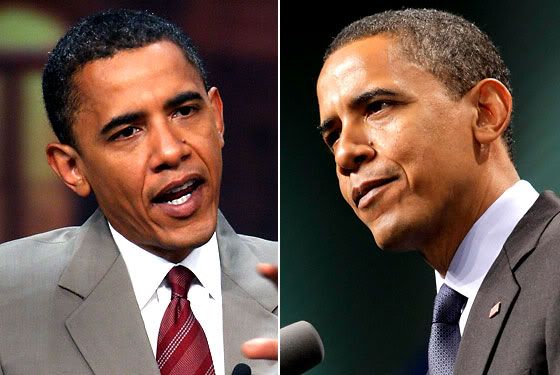
If you look at photos of President Obama taken before he ran for president and then more recently, you’ll notice a distinct difference: where there used to be only dark brown hair, there are now areas of gray dotting the landscape. It seems that the stress of running a country would turn any person’s hair gray. But is stress really to blame? And why does hair turn gray, even for those of us who don’t have jobs quite as stressful as President Obama’s?

Stress doesn’t actually turn hair gray—the color can't change once produced by hair follicles, so hair cannot suddenly turn gray if you are under a great deal of stress. If a single strand of hair starts out brown (or red or black or blond), it's never going to turn gray. Your hair follicles produce less color as they age, so when hair goes through its natural cycle of dying and being regenerated, it’s more likely to grow in as gray beginning after age 35. Genetics can play a role in when this starts. President Obama is in his mid-40s, so aging could explain his graying. But stress may have played a role, too.

Stress can trigger a common condition called telogen effluvium, which causes hair to shed at about three times the rate it normally does. The hair grows back, so the condition doesn’t cause balding. But if you’re middle-aged and your hair is falling out and regenerating more quickly because of stress, it’s possible that the hair that grows in will be gray instead of its original color.

When and how thoroughly your hair turns gray has mostly to do with the genes you inherit from your parents. Though stress may play a role in the process, it would be more helpful to look to past generations rather than your current stress levels to help you predict when or if you’ll go gray. That’s true whether you’re the President of the United States or someone with a less stressful job.

Source: http://health.msn.com/health-topics