Recent Posts

Showing posts with label Inventions. Show all posts

Jan 16, 2010

The World's Oldest Lightbulb still burns

Photobucket
If Adolphe Chailet had his way some 110 years ago, buying light bulbs would be a rarity. This competitor of Thomas Edison is the engineering mind behind the world’s oldest light bulb, a 109-year-old light at Fire Station 6 in Livermore, California. Not only has Chailet’s design survived several moves and a multitude of earthquakes, it’s also survived going up in voltage from 110 to 120 volts. It’s indestructible!

Even when it was built back in 1900, the Shelby-style light bulb was remarkable. During a series of challenges, Chailet’s bulb proved to have the strongest filament, surviving increasing voltage levels while competitor bulbs burned out. The so-called Centennial Light just kept getting brighter. The light stays on all day, and has only been off for a grand total of one week, during station renovations in 1937. It’s not very creatively made or exceptionally bright these days, but it’s definitely stood the test of time.

When they say that things were better made in the old days, they’re not taking into account this light. Even in the old days, they didn’t make a bulb this good! Chailet didn’t build his inventions to fail.


Nov 30, 2009

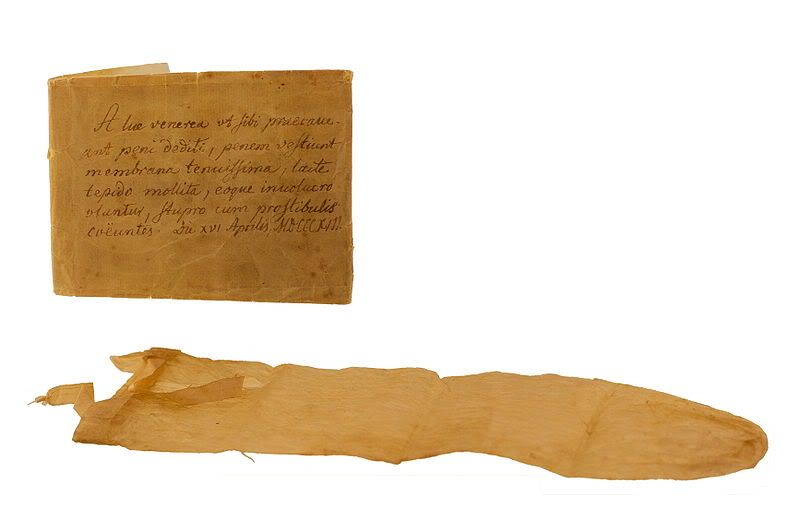
The History of Condoms

Photobucket

1000 B.C.

The ancient Egyptians used a linen sheath for protection against disease.

100-200 A.D.
The earliest evidence of condom use in Europe are scenes from cave paintings at Combarelles in France.

1500s
An Italian doctor by the name of Gabrielle Fallopius (for whom, coincidentally, the female fallopian tube was named) suggested that linen sheath condoms be used to protect against syphilis, a deadly epidemic at that time in history.

1600s
Reports say farmers in Condom, France began using sheep guts as condoms, possibly the origin of the lambskin condom.

Allegedly, the name "condom" was coined when Charles II was given oiled sheep intestines to use as condoms by a Dr. Condom or Quondam. However, some believe the name "condom" came from the Latin word "condus" which means "vessel".

1700s
The English connection may explain the name legendary lover Casanova gave to his sheath. He would never mount without his "redingote anglaise", his English riding coat.

1843
Goodyear and Hancock began to mass-produce condoms made out of vulcanized rubber, which is a stronger and more elastic material. Men are advised that these rubber condoms can be washed and reused until they crumble.

1930s
Liquid latex manufacturing supersedes crepe rubber. It is still the basis for manufacture today.

1990s
New technology has considerably improved the condom and enabled the production of far more sophisticated versions than our ancestors were used to. The latest development is Durex Avanti made from a unique polyurethane material, Duron, which is twice as strong as latex! enabling a thinner, more sensitive film.

Today
Avanti Condoms by Durex are made from a unique non-latex polyurethane film and coated in a silky smooth lubricant. Each Avanti Condom is electronically tested for durability.

Condom sales reach nine billion worldwide.

Nov 18, 2009

Rubik's Cube Facts

Photobucket
Rubik's Cube was invented in 1974 by Ernő Rubik, a Hungarian architect and sculptor. He called his invention the "Magic Cube". It was renamed the Rubik's Cube by the Ideal Toy Corporation in 1980.

More than 300 million Rubik’s Cubes have been sold worldwide. If all the cubes were placed on top of each other it would be enough to reach the North Pole from the South Pole!

Rubik applied for his Hungarian patent in January 1975 and left his invention with a small toy making cooperative in Budapest. The patent approval finally came in early 1977 and the first Cubes appeared at the end of 1977. By this time, Erno Rubik was married.

Ernő Rubik became the first self-made millionaire from the communist block and it took Erno Rubik one month to solve the cube for the first time.

The Cube has 43 quintillion different possible configurations (43,252,003,274,489,856,000 to be precise) and only ONE solution.

Nov 17, 2009

The Inventor of Coffee Cup Sleeves

Photobucket
The coffee cup sleeves used by millions of people everyday was invented by Jim Chelossi from San Carlos. It all started in 1988 when Jim had a 250 square foot building, his first coffee shop, the Coffee Club, in Belmont, California. "I didn’t know much about running a coffee shop then and opened my first one without a business license" Jim said. After a couple of years, the Coffee Club was a huge success with a total of 5 shops.

In 1991, more and more people started to ask him for a second cup on their coffee due to how hot the cup was on their hands. The cups were costing 8 cents a cup then and he had to think of a way to cut this expense.

In the San Carlos store he grabbed a napkin and created the idea of the sleeve. He drew a sketch of his idea and some rough costs on the napkin. The final cost of the sleeve was 3 cents and that was a savings of 5 cents for every sleeve he used instead of a second cup.

Then he decided to sell advertisements on the sleeve and that paid for all of the sleeves he used in the shops. Then he began selling sleeves to other distributors which would in turn sell them to other coffee shops.

That was the birth of the sleeve.

He patented his idea in 1995. A simple yet brilliant invention.

Source: http://www.mrlim.com/2008/05/interview-with-jim-chelossi-inventor-of-the-coffee-sleeve/

Nov 11, 2009

Board Games Invention

The oldest board game in the world is Senet appeared in ancient Egypt in 3300 b.c. Even King Tut had one. He liked it so much he was buried with it.

The oldest set of board gaming equipment ever found is The Royal Game of Ur, which was invented more than 4,000 years ago in Mesopotamia, the site of present-day Iraq. It was a “race” game where the first player to complete the course was the winner. Moves were governed by throwing dice-like objects. Archaeologists believe it is the forerunner of backgammon.

Parcheesi, the original male chauvinist game, was created in the 1500s in India by Akbar the Great. It was played in the palace courtyard where Akbar would sit in the middle with slave girls dressed in different colors as game pawns.

The first American board game, “The Mansion of Happiness,” was produced in 1843. Its theme was Victorian: players tried to avoid Passion, Idleness, Cruelty, Immodesty, and Ingratitude. Drunkenness was punished by a trip to the stocks.

In 1860, Milton Bradley bought a lithographic press and began printing board games. His first game was called “The Checkered Game of Life.” The object was to land on the "good" spaces and collect 100 points. A player could gain fifty points toward this goal by reaching "Happy Old Age" in the far corner, opposite "Infancy" where one began. The game board was essentially a modified checkerboard.

In 1885, Mark Twain designed and patented a game intended to help people keep historical facts straight. He called it “Mark Twain’s Memory Builder: A Game for Acquiring and Retaining All Sorts of Facts and Dates. In the introduction to the rules he wrote, “Many public school children seem to know only two dates - 1492 and 4th of July but as a rule they don’t know what happened on either occasion. It is because they have not had a chance to play this game.

Monopoly was invented by Charles B. Darrow during the Depression in 1934 and at first, the game was rejected by the Parker Brothers due 52 design errors. In its first year, 1935, game was the best-selling game in America. Standard Monopoly bank starts with $15,140 and it is estimated that Monopoly has been sold 250 million times through out the world. Mr. Monopoly is the name of the Monopoly® man.

Source: http://www.hasbro.com/monopoly/en_US/

Oct 29, 2009

History of Toothbrush

Photobucket
We bet that a lot of you think brushing your teeth is annoying. You might even try to skip it every now and then, when you think your parents won't catch you! Well, imagine what your life would be like if you didn't have a modern toothbrush to clean your pearly whites. You'd do what people did before the toothbrush was invented: Find another way.

Thousands of years ago, people wanted to keep their teeth and gums clean, their breath fresh and their teeth white, just like people do today. They found different tools with which to do it.

Before toothbrushes, people used rough cloth and water to clean their teeth. They would also rub things like salt and chalk across their teeth to try to get rid of the grime.

The ancient Egyptians made a kind of brush by splitting the end of a twig. And the ancient Chinese chewed on twigs with a special flavor to freshen their breath.

People also used forms of toothpaste that they made out of ingredients you probably wouldn't want to put in your mouth.

Sometimes a powder was made of the ashes of ox hooves and burned eggshells. The ancient Greeks and Romans used materials such as crushed oyster shells and bones.

The Chinese are believed to have made the first natural-bristle toothbrush in the 1400s by using bristles (hair) from pigs' necks. The bristles were attached to a handle made of bone or bamboo.

The first toothbrush that resembles the one you use today was made in England in the 1770s. A man named William Addis came up with the idea while he was in prison, put there for having started a riot. He didn't think the rag he was given was cleaning his teeth well enough, so he saved a small bone from a meal. He put tiny holes in it and used glue to attach pig bristles he had gotten from a prison guard.

The first patent for a toothbrush was awarded to an American named H.N. Wadsworth in 1857, but it wasn't until the invention of nylon in the 1930s that toothbrushes came to look like the ones you use.

And it wasn't until after World War II that Americans started brushing their teeth regularly. U.S. soldiers brought the daily habit back home with them from abroad, and that helped make the practice popular.

Now go ahead and admit it: It would be pretty gross if you didn't have a toothbrush to clean your teeth, wouldn't it?

Source: washingtonpost.com