Recent Posts

Apr 5, 2010

Can soap get dirty?

Photobucket
Soaps are mixtures of sodium or potassium salts derived from fatty acids and alkali solutions in a process called saponification. Each soap molecule is made of a long, non-polar, hydrophobic (repelled by water) hydrocarbon chain (the “tail”) capped by a polar, hydrophilic (water-soluble) “salt” head. Because soap molecules have both polar and non-polar properties, they’re great emulsifiers, which means they can disperse one liquid into another.

When you wash your dirty hands with soap and water, the tails of the soap molecules are repelled by water and attracted to oils, which attract dirt. The tails cluster together and form structures called micelles, trapping the dirt and oils. The micelles are negatively charged and soluble in water, so they repel each other and remain dispersed in water—and can easily be washed away.

So, yes, soap does indeed get dirty. That’s sort of how it gets your hands clean: by latching onto grease, dirt and oil more strongly than your skin does. Of course, when you’re using soap, you’re washing all those loose, dirt-trapping, dirty soap molecules away, but a bar of soap sitting on the bathroom counter or liquid soap in a bottle can also be contaminated with microorganisms. This doesn’t seem to be much of a problem, though.

In the few studies that have been done on the matter, test subjects were given bars of soap laden with E. coli and other bacteria and instructed to wash up. None of the studies found any evidence of bacteria transfer from the soap to the subjects’ hands. (It should be noted that two of these studies were conducted by Procter & Gamble and the Dial Corp., though no contradictory evidence has been found.)

Dirty soap can’t clean itself, though. A contaminated bar of soap gets cleaned via the same mechanical action that helps clean you up when you wash your hands: good ol’ fashioned scrubbing. The friction from rubbing your hands against the soap, as well as the flushing action of running water, removes harmful microorganisms from both your hands and the soap and sends them down the drain.

Source: http://www.mentalfloss.com/blogs/archives/50967

Apr 1, 2010

How did Adolf Hitler die?

Photobucket
With the end of World War 2 nearing, defeat of Germany was evident. While the war raged on, Adolf Hitler along with Eva Braun, his girlfriend of long standing, took shelter in the subterranean bunker - Führerbunker on January 16, 1945. It was located below Hitler's Reich Chancellery in Berlin. As German forces suffered one loss after another in the hands of the Allied forces, it is said that Hitler suffered a nervous breakdown on April 22, 1945. By that time the Russian army had entered Berlin and were marching on to the center of the city to capture Hitler.

Hitler consulted his physician Werner Hasse on the best way to commit suicide. Hasse suggested a dose of cyanide along with a gunshot to the head. On the suggestion of his physician, Hitler got doses of cyanide but paranoia seized him after he heard of the attempts of Henreich Himmler's to negotiate peace with the enemies. This was a big blow to Hitler's faith in his men and he started suspecting that the pills were fake. To test their authenticity, Hitler ordered the pills to be tried on his dog Blondii whom he was known to love a lot. The pet died due the poison in the capsules.

Hitler's confidence further suffered a huge setback when he heard about the execution of his Italian ally Benito Mussolini. He did not want to suffer the same fate as Mussolini and the execution of the Italian dictator made Hitler finalize his act of suicide.

On April 29, 1945 around midnight, Hitler married his long time girlfriend Eva Braun in his bunker with minimal ceremony. Later early morning Hitler is said to have signed his last will. He also granted permission for an attempt to breakout later that night to his general Helmuth Weidling. After having their lunch, Hitler and his new bride conveyed their last farewell to their men in the bunker and retired to his personal study at around 14:20 hours.

Witnesses report to have heard a loud gunshot at around 15:30 hours from the study. Hence, the answer to the question when did Hitler die is April 30, 1945 and not April 29, 1945 as it cited in certain resources. When Hitler's valet Heinze Linge opened the door of the study, he found the couple slumped on the sofa leaning away from each other. Hitler had a gunshot wound in his temple from which blood was oozing out. The smell of prussic acid, the gaseous form of cyanide, pervaded the room. Eva Braun did not have any physical injury. It was evident that she had died due to consumption of cyanide. Later reports confirmed that Hitler had also consumed cyanide.

Source: http://www.buzzle.com/articles/how-did-hitler-die.html

Mar 25, 2010

Why Are Keyboards QWERTY?

Photobucket
The arrangement of the first six letters in the top alphabet row of a standard keyboard – QWERTY – goes way back. The layout was created in 1873 when Christopher Latham Sholes made improvements to his earlier typewriter models in order to design a quicker and more efficient typewriter for E. Remington and Sons.

Sholes noticed the alphabetical layout of the keys in his original models tended to jam, so he changed their order, spreading the most common pairs of letters farther apart. Sholes' QWERTY model was named the Remington and became available as the first commercial typewriter in 1874.

Since then, many alternatives to QWERTY have been created, such as the Dvorak Simplified Keyboard (named after professor and co-creator August Dvorak) and the Colemak keyboard layout. Even though these new keyboards are designed to increase typing speed while maintaining ergonomic considerations, QWERTY remains the standard.

"The QWERTY keyboard layout was developed to reduce keys jamming on mechanical typewriters to improve typist productivity," Alan Hedge, a professor in the Department of Design and Environmental Analysis at Cornell University, where he directs the Human Factors and Ergonomics research programs.

"These days computers don't have keys that jam, but even though QWERTY isn't the optimal keyboard layout, it's not the worst and it seems that we're stuck with it," Hedge told Life's Little Mysteries.

As in other behaviors, it seems, humans are creatures of habit:

"With electronic keyboards, there is no need for QWERTY, but people have become accustomed to the design and that is why it continues to be used," explained Robert L. Goldberg, a professor at the University of California's Ergonomics Program.

Mar 22, 2010

Something about German cars

Mercedes-Benz
Photobucket
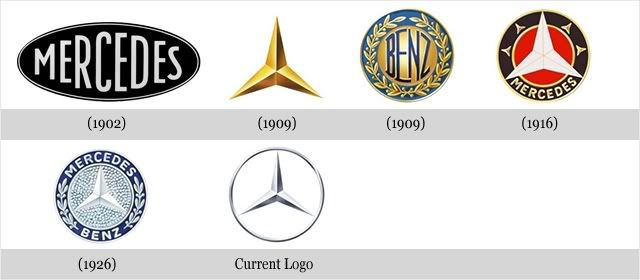
Founded in 1926 by Karl Benz and Gottlieb Daimler after the merging of their car companies, Daimler-Motored-Gesellschaft (DMG) and Benz & Cie. The name "Mercedes" came about in 1900 when a wealthy European businessman named Emil Jellinek wanted a faster car with new engine and to be named after his 10-year-old daughter’s name, Mercedes Jellink. The three-pointed stars represent their dominance on land, sea and air.

BMW
Photobucket
BMW or Bavarian Motor Works was founded in 1913 by Karl Friedrich Rapp, an aircraft engine manufacturer and Gustav Otto, a German aircraft manufacturer .Some believed that their logo represents a Bavarian flag which has blue and white cases while others believed that it represents white propeller blades against a blue sky (during World War I, BMW was a major supplier of airplane engines).

Audi
Photobucket
Founded in 1910 by German engineer August Horch, who used to work for Karl Benz. The name came from a son of his business partner, Franz Fikentscher. "Audi" in Latin means "listen", which is "Horch" in German (Horch was August's former company). The four interlinked rings logo represents four car makers Audi, Horch, DKW, and Wanderer when they merged to form Auto Union in 1932.

Volkswagen
Photobucket
Founded in 1937, Volkswagen (German for "People’s Car") was originally a proposal from Adolf Hitler to Ferdinand Porsche, the car designer to design a car that can fit 5 people and deliver speed of 100km/h (62mph). He instructed that the car should look like a May beetle. Later it was found out that Hitler transformed the car into a war vehicle that carries 3 men, a machine gun and ammunition. It was only after the war in 1946 that the Volkswagen finally became the “Peoples Car” after the British took over.

Porsche
Photobucket
Ferdinand Porsche founded Porsche in 1931. Interestingly, he was the engineer for the first Volkswagen created, hence the first Porsche made used machinery from the Volkswagen Beetle. The first model was launched in 1938 and 10 years later the second Porsche was released, the 356. The end of the war saw Porsche participating in motor racing which proved to be highly successful. 1963 saw the launch of the Porsche 911, the most well known model, which is still in production today due to its success by the public and on the race track. The idea for the Porsche emblem came from the founder's son, Ferry Porsche. The 6 antlers in the logo date from the province emblem of Baden-Württemberg.

Mar 19, 2010

World's oldest football club

Photobucket
Sheffield FC established in 1857 is the first football club to have ever become a formalised and independent organisation, the 152-year history of Sheffield FC has been inextricably linked with the progression of the game in Britain and the growth of football into the globalised entertainment industry it is today.

Established during the height of the industrial revolution in Britain’s most prolific steel-producing centre, Sheffield FC quickly became an integral force during the gradual installation of football as a more organised and systematic athletic discipline in the UK.

After the club’s foundation in 1857 the committee began to methodically analyse the various loosely regulated codes of mob football that dominated the British game at the time, eventually arriving at a standardised set of rules which were adopted by the Sheffield Football Association, football’s first formal governing body, at its establishment in 1857.

In 1863, just six years after the formation of the Sheffield FA, the club became a founder member of the Football Association, the first national bureaucracy designed solely for the purpose of administrating the game of football and a hugely significant development in the game’s journey towards professionalism.

Despite now playing their football in the semi-professional Northern Premier League, Sheffield FC’s impact on the game should not be underestimated. Indeed, the club should be lauded as a revolutionary influence and controlling presence on the early history of association football.

Mar 15, 2010

World's strongest granny


Introducing 76-year-old Sakinat Khanapiyeva from the village of Sultan-Yangiyurt in Dagestan, Russia. This pint-size old timer is the world's strongest granny, and she can tear through phone books, lift a 52-lb. dumbbell while standing on a carpet of nails, and break horseshoes.

Supergran found out how strong she was at the age of 10 when she moved a 661-lb. box of grain (that's the weight of four grown men) and has been showing her titanic power ever since. Alas, only last year did she make it into the Guinness Book of Records.

But perhaps most endearing are her wise words of wisdom. "Anyone can do anything they want," she told this news crew. "But good deeds are what matter most."

Mar 14, 2010

Do Eskimos live in igloos?

Photobucket
Eskimos do not actually live in igloos as what most people commonly think. The word "igloo" means house in one of the Eskimos dialects and not always referring to a round-shaped structure made of ice blocks. Eskimos or rather "Inuit", as what they preferred to be called live in more permanent structures.

The Inuit, and other Artic populations, have used igloos as temporary shelters for thousands of years, especially during a hunting trip. In order to find food, it was necessary for them to live a wandering life, following their migrations. Generally, they would have a summer home and a winter home. Tents made of seal or caribou skin provided shelter during the summer months and during the winter, they built igloos.

Inside an igloo, the temperature can be below zero, but when comparing to the outside, -40 degrees Celcius, it is still much warmer. Igloos are surprisingly strong and can hold the weight of the builder standing on top. The important thing about igloos is that they are relatively easy to build (with practice) and can be built very quickly (10 minutes) and it uses a resource that there is plenty of in the artic, ice and snow.